
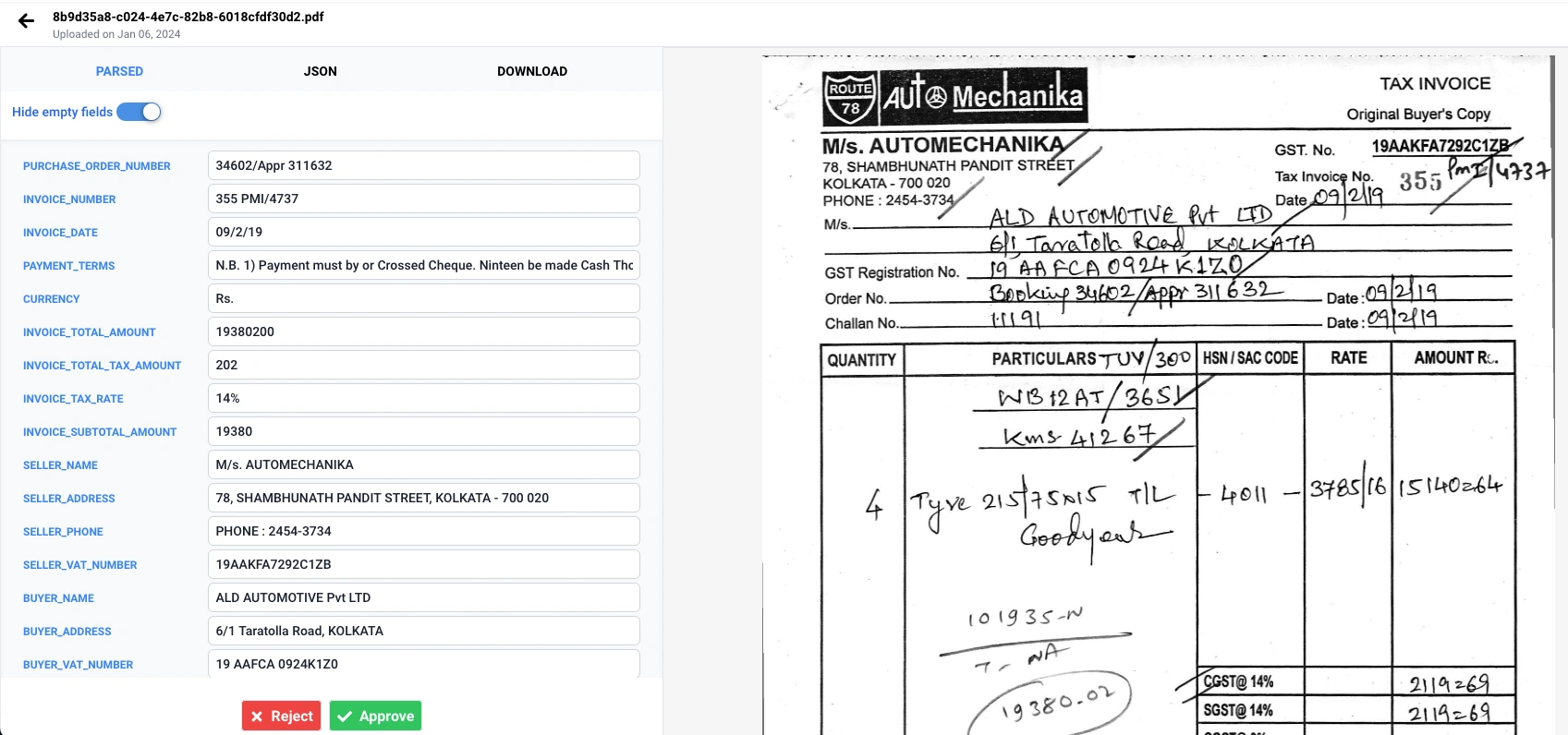
Your customers are asking for it. Upload an invoice, a purchase order, a statement, and have the data land in the right fields automatically. Your product manager has it on the roadmap. And your engineering team has looked at the problem and concluded, reasonably, that it does not look that hard.
They are right about the demo. A multimodal LLM and a well-written prompt will extract fields from a clean PDF in an afternoon. What the demo hides is that document extraction is a long-tail problem: the first 80% takes a week, and the last 20% becomes a permanent squatter on your backlog.
This guide lays out what building actually involves, what buying actually costs, and a framework for making the call. We build extraction infrastructure for a living, so we have a position, but we will be specific about the cases where building is the right answer.
What "Build" Actually Means
The prototype is an API call. The production system is a pipeline. Between the two sits everything the demo never encounters:
An OCR and parsing layer. Digital PDFs, scans, and phone photos need different handling before extraction can start. Multi-column layouts, rotated pages, tables that span pages, and low-resolution faxes each break naive approaches differently. Most teams end up stitching together two or three engines and routing between them.
A semantic extraction layer. Raw text is not data. Something has to know that "Inv No", "Invoice #", and "Ref." are the same field, that European dates are not American dates, and that a negative line item on a credit note is correct rather than an error. LLMs do much of this well now, but raw LLM output brings its own failure modes: field names that drift between runs, values hallucinated on degraded scans, and no native concept of "required field missing."
A validation and confidence layer. Production systems need to know when not to trust themselves. That means per-field confidence scoring, schema enforcement, type coercion, range checks, and a review queue for documents that fail them. This layer is where "works in the demo" and "trusted by your customers" diverge, and it is routinely half the total engineering effort.
The operational wrapper. Multi-page handling, batch processing, webhooks, retries, rate limiting, cost controls on token spend, monitoring, and per-customer schema configuration if you serve more than one customer. None of it is intellectually hard. All of it is time.
A realistic estimate for a production-grade version of this pipeline is two engineers for four to six months, and that buys you version one.
The Cost That Actually Hurts Is Maintenance
The build-vs-buy math is usually framed as upfront cost, and that framing is wrong. The dominant cost is the long tail.
Every new customer brings new vendors, and every vendor brings a layout your pipeline has never seen. The eleventh vendor puts the invoice number in the header. The twelfth sends two-page PDFs. The thirteenth photographs paper on a warehouse floor. At small scale these are anecdotes; at production scale, edge cases are the workload.
Model churn compounds this. The LLM landscape turns over every few months, and each provider change or model deprecation means re-testing extraction accuracy across your document corpus, which means you need a document corpus, ground-truth labels, and an evaluation harness. That is a second product your team now maintains.
The honest unit of measurement is not "engineering months to build" but "a permanent fractional engineer, forever." For most platform teams that is 25% to 50% of a senior engineer's time in perpetuity, spent on a system your customers only notice when it fails.
What "Buy" Actually Means
A purpose-built extraction API collapses that pipeline into a contract: send a document, get validated JSON in your schema, with confidence scores that tell you when to route to human review.
What you are paying for is not the extraction call. It is the absorption of the long tail. When a vendor changes a layout, when a model needs swapping, when a new document type appears, that lands on the vendor's roadmap instead of your backlog. Our developer guide to document AI APIs covers how these APIs work and how to evaluate them in depth.
The honest costs on this side:
Per-document unit economics. At very high volume, a tuned in-house pipeline can beat API pricing on marginal cost. You need to be processing hundreds of thousands of documents a month before this crossover typically matters, and the comparison only holds if you exclude the engineering payroll that built and maintains the pipeline.
A dependency. You are trusting a vendor with a workflow your customers see. Evaluate them like infrastructure: SLAs, data processing terms, deletion policies, and what happens to your product if they have a bad week.
Schema fit. Your document types have to be expressible in the vendor's schema system. Good vendors make this flexible; test with your ugliest real documents, not their sample invoices.
The Decision Framework
Build if:
- Document extraction is your product, not a feature of it. If extraction accuracy is your competitive moat, own the pipeline.
- You have hard constraints that prohibit third-party processing, and a compliance team that has confirmed no vendor arrangement (DPAs, private deployments) satisfies them.
- Your documents are genuinely uniform: one format, one source you control, no external parties. A template parser is a weekend project; do not buy a platform for it.
- Volume is trivial. Under ~50 documents a month, an LLM call with careful prompting and human eyeballs on the output is fine.
Buy if:
- Extraction is a feature your customers want, but your roadmap is somewhere else. The strongest argument for buying is not cost; it is that your best engineers should be building the thing only your company can build.
- Documents come from parties you do not control. External vendors, suppliers, and customers guarantee layout variation, and layout variation is the long tail.
- You need to ship in weeks. Four to six months of pipeline work is four to six months your competitor spends shipping the feature.
- You are embedding extraction in a customer-facing product and need validated, consistent output with confidence scores from day one, because your customers' trust is on the line, not just your ops team's patience.
The hybrid worth considering: some teams buy the extraction layer and build thin domain logic on top: custom validation rules, ERP mapping, review workflows tuned to their users. This captures most of the differentiation at a fraction of the maintenance surface.
A Worked Example
A vertical SaaS platform for distributors wants supplier invoice ingestion. Two paths:
Build: two engineers, five months to production. At a loaded cost of $180K per engineer-year, that is $150K before the first customer document flows, plus roughly $45K to $90K per year in ongoing maintenance. Feature ships in Q3 instead of Q1.
Buy: integration in one to two sprints, roughly $10K to $15K of engineering time. Per-document API costs scale with usage and land on the cost-of-goods line, where they can be priced into the customer's plan. Feature ships this quarter, and the two engineers spend those five months on the platform's actual roadmap.
The build path only wins this comparison when volume is enormous, requirements are truly bespoke, or extraction is the product itself.
Frequently Asked Questions
How long does it take to build document extraction in-house? A demo takes days. A production pipeline with OCR handling, semantic extraction, validation, confidence scoring, and operational tooling typically takes two engineers four to six months, plus permanent ongoing maintenance as document formats and models change.
Is it cheaper to build document parsing than use an API? Rarely, once maintenance is counted. In-house pipelines can achieve lower marginal per-document cost at very high volume, but the crossover typically requires hundreds of thousands of documents a month, and the comparison usually omits the ongoing engineering time that layout drift and model churn consume.
Can I just use GPT or Claude instead of building a full pipeline? For prototypes and low volume, yes. At production scale, raw LLM calls need a reliability layer you build yourself: schema enforcement, validation, confidence handling, multi-page stitching, and cost controls. That layer is most of the work, which is what purpose-built extraction APIs sell.
What should I look for in a document extraction API? Schema-consistent JSON output, per-field confidence scores, no template training requirement, handling of scans and multi-page documents through one endpoint, webhook support for async processing, and data processing terms your compliance team will sign. Test with your worst real documents before committing.
When does building in-house make sense? When extraction is your core product, when compliance genuinely prohibits third-party processing, when documents are uniform and fully under your control, or when volume is too small to matter. Outside those cases, the maintenance long tail usually makes buying the better engineering decision, not just the better financial one.
The Bottom Line
The build-vs-buy question for document extraction is really a question about where your engineering time creates the most value. Building means owning a pipeline whose hardest costs arrive after launch. Buying means shipping the feature now and letting a vendor absorb the long tail of layouts, models, and edge cases.
If you want to see what the buy path looks like concretely, DocumentPro has a free tier: define your schema, send a real document, and get validated JSON back in minutes. Get API access or talk to us about your use case.
Also read: Document AI API: The Developer Guide | How to Extract Data from Invoices | Extracting Data from Documents with LLMs